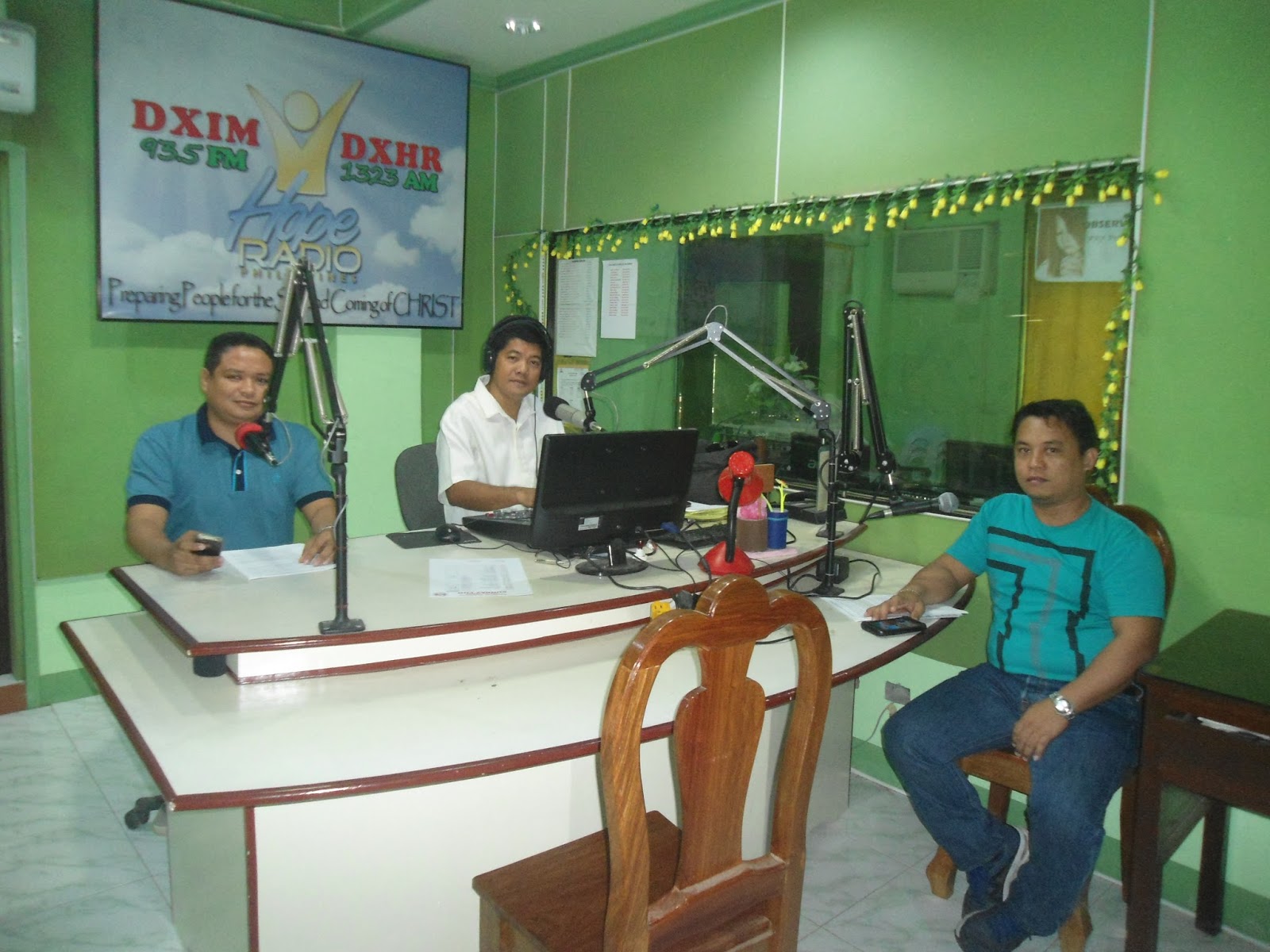
Last broadcast of DA Caraga's radio program "Bahandi sa Kaumahan" aired over DXIM FM 93.5 MHz Hope Radio Butuan for the year 2016 on December 26.
Thank you for all, who one way or the other contributed to the program especially to all my listeners the farmers and fisherfolks.
GOD Bless us all! It's me your program anchor Paglaum Aurell P. Arais.
Be informed...updated...and more...Your source of valuable information through your friendly media practitioner, Mighty Aurell
Tuesday, January 17, 2017
Friday, September 30, 2016
QUENDANCOR Offers Amnesty Program for their Borrowers
| Bahandi sa Kaumahan on Hope Radio studio with Quedancor as guests |
To help borrowers settle
their long overdue accounts, the Quedan and Rural Credit Guarantee Corporation
(QUEDANCOR) is now offering a program dubbed as Quedancor Amnesty Program
(QAP).
This was announced by
Engr. Christopher Gilos, OIC Regional Assistant Vice President for Caraga and
Property Appraiser for Mindanao Area in a radio interview as guest on Bahandi sa Kaumahan radio program over
Hope Radio Butuan yesterday, August 8, 2016.
Gilos said that under QAP,
the remaining principal amount will be settled; the penalty will be waived 100%;
interest will be slashed down up to 75% if paid in full or up to 50% if amortized
within three years.
Dave Iligan of Quedancor
Regional Communications and Records Management Office said that borrowers and
co-makers can avail of the amnesty program.
They are advised to visit
the nearest Quendancor provincial offices for complete details on QAP.
Quendancor, is an attached
agency of the Department of Agriculture credit resources into the countryside
so as to trigger the vigorous growth and development of rural productivity, employment
and enterprises.
Bahandi
sa Kaumahan is a flagship radio program of the
Department of Agriculture Caraga to update its listeners on projects and
programs as well as advocacies for agricultural development. (Aurelius P.
Arais/DA Caraga)
-=###=-
Tuesday, September 27, 2016
Women Empowerment through DA-SELAP
This is how members of the Tagbuyacan Rural Improvement
Club (RIC) describe their current plight after accessing a project through the
Support to Emergency and Livelihood Assistance Project (SELAP) Phase II of the
Department of Agriculture Caraga.
Tagbuyacan is one of the barangay in Santiago, Agusan
del Norte.
Josephine Monter, president of the Tagbuyacan RIC with
30 members said that in 2013 they had availed P300,000.00 funding support from
SELAP for their Integrated Food Processing Project.
With the SELAP funding support and an additional
P34,000.00 from the local government unit, they were able to purchase a
freezer, sealer, grinder, weighing scale and chopper for their business
venture.
They were also able to purchase an initial 20 heads of
piglet and were dispersed to their members for fattening project.
Members who would want to engage in the fattening
project would have to pay P2,400 per piglet after four months, so the club has
an income of P400.00 since a piglet would cost P2,000.00.
The club now had wide array of value adding products such
as banana and camote chips and longganisa. They also operate a sari-sari store
and catering services.
Raw materials to be processed were sourced out from
their farmer members, thereby ensuring market for the farmers.
To ensure regular operation of their store, they hired
a store attendant with a monthly salary of P2,500.00.
She said that every month they were able to process
about 100 kilos of banana (cardava) and 20 kilos of camote for their banana and
camote chips products respectively and 60 kilos of pork for their longganisa
and for catering services.
As Tagbuyacan RIC manages their ventures well, other
government agency extended their support to the group particularly the
Department of Trade and Industry.
The club had availed Support Service Facility Project
adding their array of products with ube and squash flour but still utilizing
SELAP funds as capital for raw materials.
Betchaida Rojo, business manager of the club said that
their products are sold in the locality and currently being promoted to other
areas through trade fairs.
She said that for the past two years, they had been
able to give out cash dividend for the members out from the income of their
business ventures. However, those members who frequently volunteered to run
their business were compensated much higher.
“What makes us empowered is that we are no longer those
classical wives who are just relying on the income from our husbands. Nowadays
we have our own source of income to help husbands in meeting the needs of our
respective families,’ Monter said.
She said that through DA-SELAP Phase II their horizon
broadens as they have now opportunities to face other business owners and an
opportunity to travel other places especially during trade fairs.
“We are so thankful to DA-SELAP Phase II, without their
support we would remain typical wives and typical farmers”, Monter added.
=-###-=
Wednesday, September 7, 2016
DA Project Transforms Coffee Farmers to Manufacturers
| Buenas Coffee products |
Coffee remains the staple drink of Filipinos and its
demand continues to expand.
According to Philippine Coffee Board, Filipinos can
consume 100,000 metric tons of coffee a year. Hence, various companies
established their coffee products in the Philippines to grab the huge market
opportunities.
But did you know that coffee farmers themselves in
Simbalan, a mountainous barangay in Buenavista, Agusan del Norte planted and
manufactured their own line of coffee products bringing the brand name as
Buenas Coffee. The group is called Simbalan Rubber Farmers Association
Incorporated (SBFAI) with 37 strong members.
According to Lucia Morden business manager of the
association, Buenas Coffee would not have been born without the support from
the Department of Agriculture Caraga through the Support to Emergency and
Livelihood Assistance Program (SELAP) Phase II.
“We are so grateful to DA because Buenas Coffee would
have not been conceived if not with the funding support of SELAP,” Morden said.
In 2012, the Simbalan Rubber Farmers Association
Incorporated availed the P300,000.00 livelihood assistance from SELAP Phase II with
P34,000.00 counterpart from Buenavista LGU which was used to purchased coffee
de huller and coffee roaster.
Morden said that Buenas Coffee with its humble
beginning is now slowly gaining popularity among coffee lovers in the locality.
“To ensure freshness of our coffee, we process on an
order basis, most of our bulk of orders are coming from government offices and satisfied
individuals,” Morden said. With the increasing popularity and demand, some of
its products were also featured in various trade fairs in Caraga.
Buenas Coffee is in soluble form in various packaging; with
its aesthetic and aroma no doubt it can compete with commercial brands.
SBFAI can process an average of 20 kilos of coffee in a
month. The raw coffee to be processed where purchased from its member
beneficiaries. Barangay Simbalan has
77.75 hectares planted with coffee comprising 98 farmers based on data from the
Municipal Agriculture Office of Buenavista.
Morden said that aside from funding support from SELAP,
they also availed coffee planting materials from the High Value Crops
Development Program (HVCDP) of DA Caraga.
With good track record in implementing SELAP project,
other national line agencies lined up to support the association thus expanding
the business line of SBFAI such as grocery store, agri- supplies, agro-forestry
planting materials and more.
As their brand name Buenas
which means lucky, Morden said that indeed DA-SELAP Phase II brings luck to
their association. (Aurelius P. Arais/DA
Caraga)
-=###-=
Monday, July 11, 2016
DA-SELAP Hastens Development in Caraga
| DA-SELAP Phase 2 Tubo-Tubo, Cagwait FMR |
Shortens travel time, convenience to transport
agricultural and aqua products, boosts local trade.
These are just few of the perks enjoyed nowadays by the
Caraganons who are directly benefitted from the implementation of the Support
to Emergency and Livelihood
Assistance Program (SELAP) Phase II in various parts of
the region.
Since the implementation of the SELAP Phase II in 2012,
the Department of Agriculture Regional Field Office 13 had implemented 12 farm
to market roads with a total length of 8.585 kilometers amounting to P48.5
million.
All SELAP Phase II FMRs are fully concrete in adherence
of the policy implemented by the current administration to make infra projects
durable and could withstand all weather conditions.
The 12 farm to market
roads are implemented at Buenavista, Magallanes and Santiago in Agusan del
Norte; San Francisco and Malimono in Surigao del Norte and San Miguel, Lanuza
and Cagwait in Surigao del Sur.
These include the two
newly completed FMRs in Cagdianao and Dinagat of the Province of Dinagat
Islands.
The said projects were
turned-over by DA Caraga to the LGU recipients last June 20, 2016 and on June
24, 2016 at Cagwait, Surigao del Sur.
Side by side with the
implementation of the farm to market roads are livelihood components to hasten
the development of the service areas.
A total of 19 livelihood
projects were implemented amounting to P5.7 million and currently managed by
the people’s organizations.
Each
PO were funded P300,000.00 for their livelihood projects ranging from food
processing, handicraft making and value added products from abaca and coconut.
Mayor Marc Adelson Longos
of the Municipality of Cagdianao said that DA is the biggest contributor in
terms of project for the development of their town.
“I am so grateful that DA
Caraga keeps coming back here in our place to pour projects in our locality,
which certainly helps in solving our problem particularly the road network,”
Longos said.
Members of the Samahan ng
mga Magsasaka sa Cagwait (SAMACA), a recipient of the livelihood project in
Cagwait, Surigao del Sur now supplies abaca handicraft in a well known resort
in Surigao del Sur benefitting its members with an additional income for the
family.
To ensure its
sustainability, DA Caraga Regional Director Edna Mabeza urged the respective
LGUs to conduct regular monitoring of the SELAP implemented projects.
“It is important that the
project will sustain for a longer period of time so that recipients would enjoy
its benefits even after the government interventions since SELAP is already on
its final stage,” she said.
The
Support to Emergency and Livelihood Assistance Project (SELAP) is a special
project of the Government of the Philippines executed by the Department of
Agriculture funded under the US Public Law 480 (US PL 480).
It
is primarily designed to cater to the needs of the poorest or marginalized areas
in Mindanao. It is implemented in Regions IX, XI and Caraga.
SELAP
Phase 2 had been implemented since 2012 and supposed to terminate last year but
it has been extended until June this year while SELAP Phase 1 run from 2006 to
2011. (Aurelius P. Arais/ DA Caraga)
=-###=-
Tuesday, July 5, 2016
DA Caraga and LGUs Prepares for Rainy Season
Prevention
is better than cure!
An
approach embraced by the Department of Agriculture Regional Field Office 13 and
its counterparts in the local governments in anticipation for possible
emergence of pests and diseases on rice amid the incoming rainy season.
In
Surigao del Sur, DA and the Provincial Agriculture Office conducted a talakayan with the farmers about rice
pests and diseases last June 12-17, 2016.
| One of the cluster in Cantilan, SDS with your blogger as facilitator |
The talakayan (forum) was conducted in 7
clustered sites attended by almost 500 farmers and agricultural extension
workers (AEWs) from 17 municipalities and two component cities, Bislig and
Tandag.
Surigao
del Sur Provincial Agriculturist Marcos Quico appealed to the AEWs to
strengthen pest monitoring in their respective areas.
“I am
urging all farmers to enhance the two way communication between farmers and
agri-extensionists in order to address promptly in case of pests and diseases
emergence,” Quico said.
DA
Caraga Field Operations Division Chief (FOD) Rebecca Atega stressed the need
that farmers should be resilient nowadays to sustain production amidst weather
uncertainty.
“Our
farmers need to be vigilant and capacitated on what to do in case of pests’
infestation to ensure food supply for the Filipinos,” she said.
Same
activities are on the pipeline to be undertaken in other areas in Caraga for the
coming days.
Last
cropping season, some municipalities of Surigao del Sur experienced mild
infestation of BPH where the situation had been curb earlier with adequate
technical knowhow of the affected farmers.
As
preventive measures for the current planting season, Surigao del Sur LGUs and
DA will distribute metarhizium as an initial application to the farms against harmful
insects affecting rice such as BPH and Rice Black Bug.
Metarhizium
anisopliae, formerly known as Entomophthora anisopliae (basionym), is a fungus
that grows naturally in soils throughout the world and causes disease in
various insects by acting as a parasitoid. The fungus then develops inside the
body eventually killing the insect after a few days through a disease called
green muscardine disease because of the green color of its spores.
Metarhizium
anisopliae is one of the biocontrol being developed in RCPC Caraga situated at
Trento, Agusan del Sur. (Aurelius P.
Arais/DA Caraga)
=-###-=
Thursday, June 23, 2016
DA Caraga Turns-over Modern Corn Drying Facility to Agusan Farmers
| Turn-over of key of responsibility with DA RED Edna Mabeza and Mayor Rosales |
To
help corn farmers attain premium quality of their produce, the Department of
Agriculture Caraga turned-over another Village Type Corn Postharvest Processing
Center to the farmers through the local government unit of Las Nieves, Agusan
del Norte last June 1, 2016.
The
second unit established in the said town and third in the region, the Village
Type Corn Postharvest Processing Center situated in Brgy. Pinana-an, is a
modern drying and shelling facility worth P3.5 million pesos and has a capacity
of processing 10 tons of corn.
The
facility will process either freshly harvested corn in cob or shelled kernels
that need further drying just for a very minimal fee.
DA
Caraga Regional Director Edna Mabeza said that modern drying facility helps to
eliminate poor quality of corn that may pose health hazard to human and animal
due to aflatoxin.
“There
are reports based on laboratory test results that some areas are having high
aflatoxin level of corn produce which primarily means delayed drying after
harvesting,” she said.
According
to corn quality parameter, aflatoxin level of corn for feed purposes must not
exceed the tolerable limit of 50 parts per billion (pbb) and for human
consumption of not more than 20 pbb.
Las
Nieves Mayor Avelina Rosales extended her gratitude to DA Caraga for supporting
their corn farmers and vowed to implement measures to ensure sustainability of
the project.
“I
am urging the farmers to help maintain the facility because it is a
multi-million peso project from the government and be cooperative on the policy
that we are going to implement to make this project sustainable,” she said.
Aside
from corn, the facility is also designed to dry palay thus making it more
advantageous for the farmers.
The
first Village Type Corn Postharvest Processing Center funded through DA is
located at Brgy. Tiniwisan, Butuan City, followed by at Brgy. Malicato of Las
Nieves and the third is the recently turned-over.
More
of this kind is on the pipeline for completion in various parts of the region
implemented under AgriPinoy Corn Program. (Aurelius P. Arais/DA Caraga)
=-###-=
Subscribe to:
Posts (Atom)