Tuesday, October 16, 2018

Government Allocates Loan Support for Farmers to Boost Rice Production


To help boost rice production in the country, the government is extending funding support for the farmers in irrigated areas.
Dubbed as Sikat Saka, a lending support exclusively for irrigated areas through Land Bank of Philippines (LBP), a total of P1.6 billion has been allocated for the program nationwide that started since 2012.
Initially, the program covered only 25 provinces but eventually expanded to 45 provinces in the country. In Caraga Region, Agusan del Sur is the sole province covered by the program since Agusan del Sur has the biggest area of rice production among five provinces in the region with almost 50,000 hectares.
Maria Theresa Espinido, Agricultural Program Coordinating Officer of Agusan del Sur said that Department of Agriculture conceptualized the Sikat Saka in support to the Food Staples Sufficiency Program.

“This program aims to help palay farmers to access timely, adequate and affordable production credit,” she explained.
Under Sikat Saka, a small farmer in an irrigated area duly endorsed by an accredited irrigators’ association through National Irrigation Administration (NIA) can access credit assistance of P41,000 per hectare for inbred and P50,000 per hectare for the hybrid.
Small farmers refer to farmer tilling at least one half (1/2) hectare of irrigated land but not to exceed five (5) hectares.
“Currently, a total of 60 farmers had already availed the lending program amounting to P5 million and we are encouraging other farmers to avail the fund,” Connie Galeon of Land Bank of the Philippines South Caraga Lending Center said.
Funding support can be utilized solely for palay production based on farm plan and budget certified by the respective local government unit.
Sikat Saka has a diminishing interest rate starting from 15% down to 9% per annum upon reaching the eighth crop cycle. (Aurelius P. Arais/DA Caraga)
                                                                       
                                                                         -=###=-

Thursday, October 4, 2018

Ensuring Food Supply thru Consumers and Farmers Resiliency


Amidst the current spike of the price of rice, members of the Grains Monitoring Team (GMT) in Caraga Region is eyeing strategies to promote resiliency among consumers and farmers.

Melody Guimary, corn program coordinator of the Department of Agriculture Caraga said that rice is not the only source of carbohydrates but to include other food staples such as banana, root crops, and corn.

“It is high time that people should try to explore other food sources such as corn grits, ” Guimary said.

She said that DA is currently campaigning for the consumers to include corn in their table through Rice Corn Blend (RCB).

“On their preference ratio, consumers may mix corn and rice to lessen the cost of food in the family since price of corn is lower than rice to almost double, thus extending the value of peso ” Guimary explained.

She also said that DA is aiming to boost production of the flint type white corn through the establishment of model farms currently at Las Nieves and Prosperidad, Agusan del Sur.

Aside from production, DA is also embarking for aggressive marketing through establishing local processors to engage in processing and blending of rice and corn for convenient access of the consumers,” she said.

Rice and corn might be blended based on consumer preference such as 70:30, 50:50 or it can be 100% pure corn.

“One of the strategies to boost corn production in the region for human consumption is establishing corn processing equipment along side with the established Rice Processing Complex (RPC) so that RPC could not only process rice but to include corn, ” Guimary added.

Marissa Garces, rice program coordinator said that cooperators of RPC in the region, are currently capacitated to be agricultural traders.

“We are helping our RPC farmer cooperators through training not only to process rice but to engage in trading, with the provision of the needed equipment and capitalization so they can start buying the rice produced within the community, processed and sold it at a much lower price, ” Garces explained.

As of presstime, in Caraga Region, there are six RPC’s who are fully operational, two for testing, and seven on going-construction.

GMT is a multi-sectoral body composed of members both from government and private. (Aurelius P. Arais/DA Caraga)


=-###=-


Wednesday, September 19, 2018

Corn Farming: A Vibrant Agribusiness


“I won’t consider farming a mere livelihood, it is business.”

This is how Romeo Ponio, a corn farmer of Las Nieves, Agusan del Norte distinctly defined his job as an agripreneurial.

He said that farming is business since it needs investment financially, intellectually and physically.

"In my experience for almost 30 years of farming, a hectare of cornfield needs an investment of not less than P35,000.00 to cover the needed inputs as well as land preparation” Ponio explained.

“During the whole planting season, you need your technical know-how in maintaining and caring your farm as well as a   physical visitation of the farm, “ he further said.

Ponio, a hybrid corn farmer in the town is also coined as magsasakang siyentista since he has been consulted by fellow farmers regarding farm production.

“To maintain good harvest, aside from following the right technology, it is important to switch to another variety after 2-3 harvest,” he explained.

He said that maintaining the same variety of corn would affect the vigor of the plant so it is recommended to change variety every now and then.

He further said that a hectare would normally harvest 8-10 metric ton (MT) sold at a prevailing farmgate price he would have recovered more than his investment.

"If you can sell your produce at P13.00 a kilo then you would have a net income of around P70,000.00 in a hectare,” Ponio said.  

In marketing, he said that it is not a problem since buyers are the one who will look and approached him even before harvest time. 

The town of Las Nieves has been identified by the Department of Agriculture as a corn cluster area having more than 1,000 hectares planted with corn both hybrid and open pollinated variety (OPV).

For those who are planning to engage in farming but not yet sure what to plant, he enticed them to choose corn.

“In corn farming especially hybrid, you don’t need to devote more of your time since it is less labor and easy to sell comes harvest season,” he concluded. (Aurelius P. Arais/DA Caraga)


=-###=-

Wednesday, August 15, 2018

DA Caraga, LGU Unite to Boost Livestock Industry

" In unity, there is strength."

This is the principle that holds government livestock expert in Caraga Region to unite and conduct "bayanihan" system in serving the livestock industry.

Heat synchronization for large ruminant
Dubbed as Joint Livestock Outreach Program held on July 23 to 27, 2018, the group serves the farmers in the Province of Dinagat Islands (PDI) particularly in the towns of Cagdianao, San Jose and Dinagat.

The group was comprised of pool of experts from the Department of Agriculture (DA) Caraga through its livestock section and the Regional Animal Disease Diagnostic Laboratory (RADDL), livestock technicians from local government units of Butuan City, Agusan del Sur, Surigao del Sur and PDI.

Farmers were able to access services such as heat synchronization and artificial insemination for ruminants, deworming, vitamin supplementation, blood sampling and surra disease treatment.
A total of 128 farmers were served with their various farm animals such as cattle, carabao, horse, goat, poultry and swine.

Carlos Ringga, 57, a resident of Purok 3, Sta. Rita, Cagdianao, PDI brought his two carabaos during the bayanihan to avail the services being offered.

“I am so thankful that the government is bringing this kind of services of us. It is a big help for my animals as they are my partner in tilling my farm planted with cassava and camote,” Ringga said.
Veterinarian Esther Cardeño,  who is the chief of RADDL, explained that it is important that animals should be physically checked for early detection of any disease or abnormalities.

“No amount of medical treatment is as effective as early detection. This is our first line of defense against any diseases,” Cardeño said.

The bayanihan team regularly conducts its outreach program in different municipalities in Caraga Region to cater the needs of the farmers especially in areas who lack manpower in catering farm animals in their locality. (Aurelius Arais/DA-Caraga)


                                                                        -=###=-

Thursday, August 9, 2018

Reaching Out the Farmers through IEC Materials


Reading materials reinforces learning.

Municipal Agriculturist Theresa Ilogon of Madrid, Surigao del Sur said that information and education campaign (IEC) materials helped them in teaching the farmers.

“We are so thankful that DA regularly distributed IEC materials for our farmers, it’s a big help for them,” Ilogon said.


DA Caraga IEC Distribution to LGUs


She said that it is easier to teach the farmers if there are reading materials on hand than lecture alone.

“We will be conducting a meeting with farmers every now and then, such as meeting with members of the Municipal Agriculture and Fishery Council (MAFC), we can use IEC materials from DA for their additional learning,” Ilogon said.

With reading materials delivered by DA Caraga, it reinforces also their desire to maintain Farmers Information Technology Center wherein they can display various information collaterals for access of the farmers.

Meanwhile, Neptali Palero, agriculture technologist of Cagwait, Surigao del Sur appreciated the IEC materials as it will reinforce their lectures in line with the observance of the nutrition month of July.

“This nutrition month, we have various lectures on the importance of vegetables so this reading materials provided by DA will be of great help,” Palero said.

DA Caraga through the Regional Agriculture Information Section regularly produced and distributed IEC materials to local government units as part of its information collaterals covering across commodities such as livestock, high-value crops development program, organic agriculture, rice, corn and other agri-related information.

Aside from reading materials such as leaflets, booklets, and poster, DA Caraga also disseminates information through broadcast, audio video, and social media. (Aurelius P. Arais/DA Caraga)


-=###=-

An Automotive Mechanic Turns Corn Farmer


“Corn farming is our family tradition and this is our life.”

Thus, says Renato Frias, 43 years old, a resident of Purok 3, Barangay Basa, Trento, Agusan del Sur, who owned a 3 hectares farm land. 


Renato Frias tendering his corn field
He said that he was nurtured in a farming environment, that is why despite of his academic achievement as an automotive mechanic, his love remains in tilling the soil.

“My mother is a farmer who managed to send us in school through corn farming, so I am following her steps so I can help my own children in sending them in school too,” Frias said.

Kagawad Renato as fondly called since he was a former barangay councilor said that aside from corn, he is planting also various vegetables. 

“Upon harvest of corn, I won’t sell everything right away, I will spare some for value adding so I can sell it on much higher price for additional income, I would sell it during flea market every Saturday together with my vegetables,” Frias said.

He said that aside from selling corn kernel, Kagawad Renato also sells crack corn, corn grits and corn bran.

Aside from his family who help him in the farm, he hired ten persons mostly his neighbor especially during planting season, thereby contributing employment on his community.

To be resilient on climate change, he patterned his planting schedule on weather condition.

“In a year, we are going to plant two times on corn, the third one will be rice, so we will be harvesting three times to maximize the time and the weather pattern,” he said.

He also revealed that he is following the technology he learned during trainings particularly Integrated Pest Management (IPM).

“I am so grateful to the Department of Agriculture and to local government unit of Trento, because once, I was hailed as an outstanding young farmer and an outstanding 4-H of the year and was given the opportunity to travel to Japan for an 8th month training with the helped of LGU and Department of Agriculture,” he narrated.

As fruit of his labor, Kagawad Renato was able to own a farm tractor, a great help in preparing his farm and also serves his neighboring farms for a minimal fee.

Currently, Kagawad Renato is a cluster leader in three barangay, the Manat-Basa-Tudela or MABATU corn cluster in the said town.

“Corn farming is a viable livelihood and a stable source for family’s income,’ he concluded. (Aurelius P. Arais/DA Caraga)


=-###-=

Tuesday, July 31, 2018

DA Caraga Boosts White Corn Consumption Campaign


In a bid to further promote white corn consumption, the Department of Agriculture Caraga is set to establish white corn model farm in two municipalities in the region this year.

DA Caraga corn program coordinator Melody Guimary disclosed that the local government units of Prosperidad, Agusan del Sur and Las Nieves, Agusan de Norte showed keen interest in establishing such model farm.

Each municipality committed to allocate 50 hectares or a total of 100 hectares in two areas to be planted with flint type white corn.

“We are targeting to materialize the project on this upcoming corn planting season between July to October this year,” Guimary said.

Model farm aims to showcase appropriate technology in producing white corn to serve as learning sites for other farmers.

For 2019, another three areas are targeted to be established as corn model farm where locations are yet to be determined.

As per guidelines, DA will provide the required seeds, fertilizer, pest and disease control inputs as well as marketing support.

White corn will be mixed with rice or as the so-called Rice Corn Blend (RCB) on a consumer preferred ratio.

RCB initiative has been led by PhilMaize Federation in collaboration with the National Food Authority (NFA).

It aims to encourage Filipinos to eat white corn to help the country attain food sufficiency and enjoy the health benefits corn has to offer.

Corn is known for its low glycemic index that is why it is good diabetics and for those body conscious persons, you will feel full much longer than consuming pure rice.

In the Philippines, Cebu is known for high consumption of corn.

In 2017 as per PSA data, Caraga Region had close to 20,000 hectares planted with white corn. (Aurelius P. Arais/DA Caraga)
-=###=-

Thursday, July 12, 2018

APCO Bridges DA to LGU


APCO SDS June Anthony Ouano (wearing blue polo shirt)
Aiming to boost partnership with the local government units, the Department of Agriculture extends its arms through the Agricultural Program Coordinating Office (APCO).

June Anthony Ouano, APCO Chief of Surigao del Sur said that APCO is an extension arm of DA regional office catering the needs of the LGU’s and other agricultural stakeholders.

“In APCO office, we have personnel assigned for cluster of LGU so they can focus on making follow-ups for any concerned that need immediate attention,” he said.

“APCO is also the window for our partners in the LGU as well as farmers who have concerns for the regional office, thereby bringing our services closer to them,” Ouano explained.

Ouano added that for any activity of the LGU or farmer associations that needs the presence of the regional office, in lieu of the regional officers who are unavailable for an equally important schedules, APCO will represent.

In Caraga Region every province has an assigned APCO.

For Agusan del Norte, APCO has been housed within the DA Regional Office through its officer Edelmira Luminarias; in Agusan del Sur ,APCO is located at the Provincial Government Center in Patin-ay, Prosperidad with its officer Maria Theresa Espinedo, for Surigao del Norte, APCO is located at Penaranda St., Surigao City while for Province of Dinagat Islands it is located at Purok 3, Don Ruben, San Jose, Dinagat Islands with officer Engr. Ricky Palatao, while APCO Surigao Del Sur is located at Brgy. Telaje, Tandag City.

The Agricultural Program Coordinating Office is directly under the umbrella of the Field Operations Division (FOD).

For convenience and faster service, you may visit at any APCO office nearest you. (Aurelius P. Arais/DA Caraga)

-===-

Sunday, June 17, 2018

IPs Cares for the Environment the SCoPSA Way

“Nature is our way of life. This is our ancestral home.”

This is how Datu Bawang, tribal chieftain of Higaonon tribe regard their tribal community in a mountainous area of Brgy. Lawan-Lawan, Las Nieves, Agusan del Norte.

“Aside from picking wild fruits, our primary means of livelihood is farming,” says Datu Bawang or Eddie Ampiyawan on his real name.

Datu Bawang, chairperson of the Lekda Higaonon Farmers Producers Cooperative (LeHFaPCo) with 30 members said that their practice in farming was to clear a piece of land in hilly areas, plant corn, harvest then leave the area and look for another area to cultivate crops.

In the process, hilly areas left barren and in danger of a landslide. But their traditional way of farming had ended after embracing a project of the Department of Agriculture that somehow changed their outlook towards the environment.

Dubbed as Sustainable Corn Production for Sustainable Agriculture (SCoPSA), a project introduced to the community in 2017 through the Bureau of Soils and Water Management (BSWM).

Prior to the implementation of SCoPSA in a particular site, it should pass the criteria such as accessible and connected to nearest farm-to-market roads; visible to other farmer as a show window of soil and water conservation technologies in the locality; free from any land tenure problems; among others.

After which, soil conservation development plan will be mapped out and corresponding technical training will be conducted for the involved stakeholders including the farmer –cooperator in preparation for the actual establishment of the farm.

The project aims to enhance productivity level of corn farmers through the promotion of a sustainable land use management that will enhance agricultural livelihood and restore ecological balance in sloping areas of the country cultivated with corn.

Technologies  demonstrated  in  the  farm is focused  on  soil  erosion  control  and  gully stabilization coupled with soil fertility improvement, such as contouring, buffer cropping system, crop rotation, among others.

“Never in our imagination could those abandoned hilly areas still be utilized again as a source of our livelihood. Nowadays, no need for us to leave and look for new a area to be cultivated,” Datu Bawang said.

“SCoPSA teaches us the value of a piece of land, which could sustainably, provides us food and means of our livelihood,” he added.
Appreciating the benefits of the program, 3 hectares had been initially developed in SCoPSA way, and currently, it has increased to 15 hectares.

Through the Bayanihan spirit among coop members, the area had been planted with corn, banana, coffee, mangosten, durian, and pineapple, wherein the planting materials had been given from the Department of Agriculture with support from the provincial government of Agusan del Norte.

“We already harvested 40 sacks of corn, so it helps us for our food,” Datu Bawang said.

Provincial Agriculture Office of Agusan del Norte provided technical support to the tribe especially on pest monitoring to ensure a good harvest.

“To help our IP brothers, the provincial government trained and provided an allowance to two tribe member as para-technician,” said Oscar Tuyor, provincial corn coordinator.

Soon farmers in Lawan-lawan, some 46 kilometers from Buenavista Poblacion, will experience ease in transporting agricultural products as an on-going construction of a national highway going to Bukidnon, traversed in the area.

In Caraga Region, 3 areas had been identified as SCoPSA sites since last year including Brgy. Malapong in Buenavista, Brgy. Culit in Nasipit and Brgy. Lawan-Lawan in Las Nieves, Agusan del Norte.  Additional areas are still under validation. (Aurelius P. Arais/DA Caraga)


=-###=-


Wednesday, June 6, 2018

Aggie Chief Launches Easy Access Loan Program for the Farmers


The government is beefing-up its effort to alleviate the economic conditions of the farmers and fisherfolks in the countryside.

Agriculture Secretary Emmanuel “Manny” Piñol launched a nationwide credit program for the farmers and fisherfolks dubbed as Production Loan Easy Access (PLEA) Program.

The launching ceremony was held at Malimono, Surigao del Norte some 32 kilometers away from Surigao City on June 26, 2017.

Through PLEA, marginal and small rural farmers and fisherfolks in the area can loan an amount of up to P50,000.00 with no collateral.

Borrowers can pay the loaned amount from 2 to 10 years depending on the commodity or activity with only 6% per annum or 0.5% per month interest rate.

During the launching ceremony Secretary Piñol awarded to Malimono Multi-Purpose Cooperative an amount of P15 million as lending conduits where borrowers can access the said loan program.

“Our farmers have 3 basic needs which is technology, financing and marketing, and PLEA is one of the answers to their financial needs,” Piñol said.

The loaned amount is intended to finance any agricultural or fishery production activities covered with insurance through the Philippine Crop Insurance Corporation (PCIC).

However beforehand a farmer and fisherfolk could access the loan, they shall be enrolled in the Juan Magsasaka’t Mangingisda Database System and issued with an intervention card.

Prior to the launching in Malimono, DA Central Office through the Information and Communications Technology Services (DA-ICTS) conducted a data gathering activities through an interview and geo-tagging the farmers and fisherfolks to identify the location of their farms and fishing grounds.

“The reason why farmers are hesitant to lend money from the banks is due to numerous documents needed, that is why we simplified the process, once you are registered in our database system and issued with Juan Magsasaka’t Mangingisda Card you are now eligible for the loan program,” Piñol explained.

PLEA with funding support of up to P20 Billion through the Agricultural Credit Policy Council (ACPC) is targeting around 2 million families across the country. (Aurelius P. Arais/DA Caraga)


=-###=-

Thursday, June 29, 2017

DA Caraga Promotes Urban Agriculture

Urban areas can be a productive source of food through urban gardening.

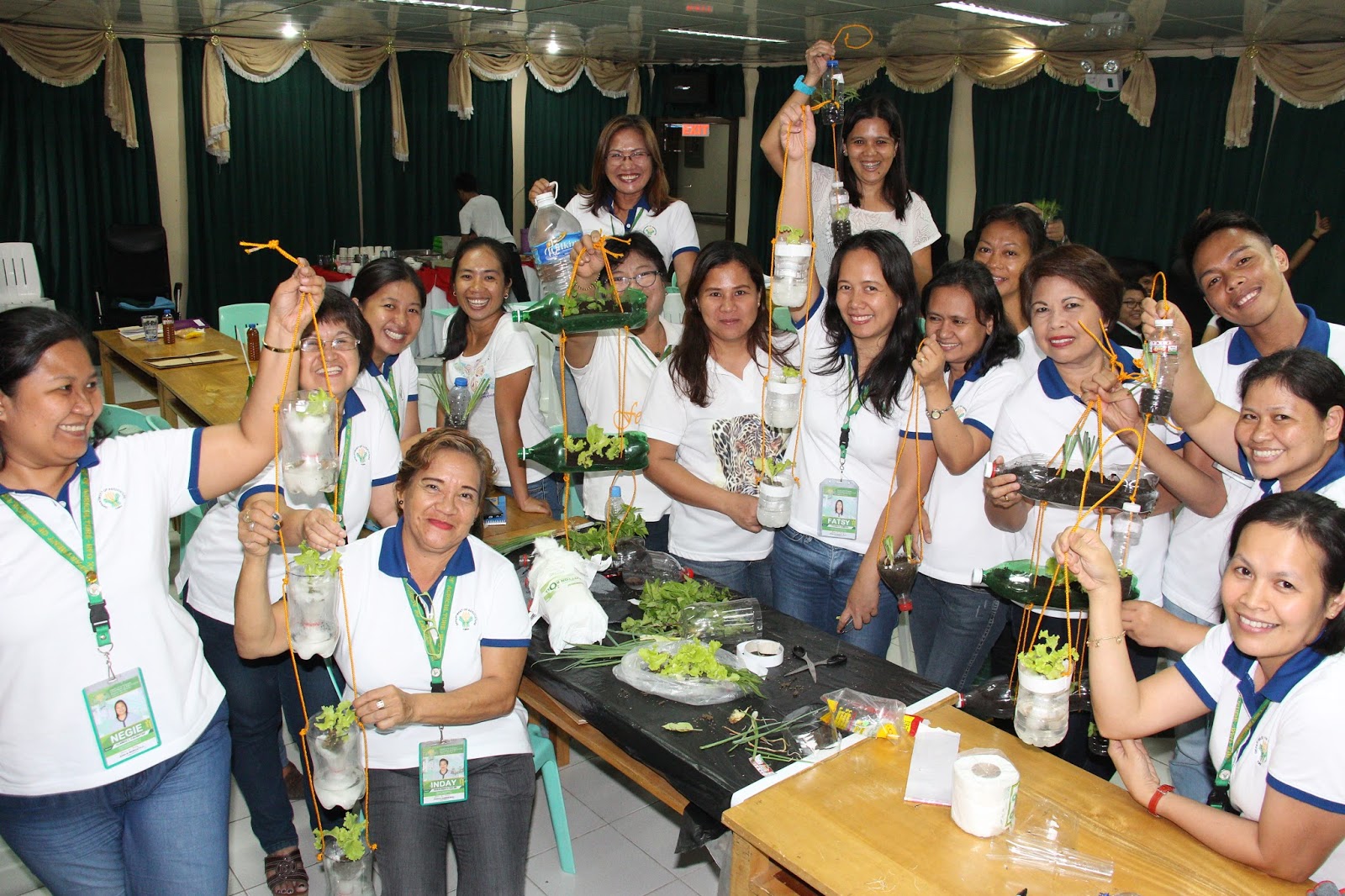
Thus, Gender and Development (GAD) Program of the Department of Agriculture Caraga conducted an urban agriculture and gardening training for DA employees on May 31, 2017.

Participants proudly pose with their output
DA-GAD focal person Isabelita Ocampo said that they intend to include all DA employees on the said training hence it is divided into four batches with the recent as first batch.

“Each of DA employees can be a role model for our respective community in promoting urban gardening; in the process we can help attaining food sufficiency,”  she said.

Participants were taught how to plant vegetables and herbs and spices in an environment friendly way with resource persons Norvien Mantilla and Geovani Jabagat of Research Division.

With limited space on urban areas, participants learned how to plant utilizing empty plastic containers, thereby it promotes recycling. 

Ocampo said that through urban gardening, families could ensure safe and healthy foods.

“No need for us to buy vegetables or species from the market since we have our own source and at the same time we can use our plants in beautifying our respective homes,” she said.

One of the participants, Rosalinda Galon, who planned to retire soon of Agribusiness and Marketing Division (AMAD) said that what she learned could be a possible avenue for her to attend to after her retirement.

“When I retire at least through gardening I still have source of income, enjoyment, physical fitness, and I can employ house aesthetic more,” Galon said.

DA Caraga Regional Director Abel James Monteagudo lauded the activity as he encouraged each and every employee of DA Caraga to be an advocate of urban agriculture. (Aurelius P. Arais/DA Caraga)

=-###=-

Sunday, June 4, 2017

Vegetable Garden by the Sea

Actual photo of the garden by the sea
Can you imagine a vegetable garden in the middle of the sea? Does it sound peculiar?

It may sound unusual from other places but not in Barobo, Surigao del Sur.

Ermilinda Cortez, a resident of Sitio Anunang, Brgy. Gamut in the said town raised a vegetable garden in the fish pen located few meters way from the seashore.

She said that while conducting monitoring on the milk fish (bangus) production project under the Anunang Gamut Fishermen Association (AGFA), a project funded by  Department of Agriculture through the then Mindanao Rural Development Project it tickled in her mind to raise vegetables to maximize her time.

Ermilinda is a member of the monitoring team in the said association.

“Since I was a child, I really love gardening so every time I have a chance, I would do it,” she said.  

She then started to bring soil every time she visited the project riding in the small banca and placed it in the plastic container and used sacks.
Interview with Ermilinda Cortez of Sitio Anunang, Gamut, Barobo, SDS

From the vegetables seeds she received from DA through Municipal Agriculture Office of Barobo she sowed it diligently.

She tendered various vegetables such as vine spinach (alugbati), kangkong, bottle gourd (upo), petchay, lemon grass (tanglad), string beans, tomato and more.

Watering the plants is the tedious part since it is located in the sea with no source of fresh water. To solve her dilemma, she innovated a way to capture the rainwater. She put a gutter in the roof of the small hut within the fish pen and drained it to a water container through a funnel and a hose.

With tender care, the vegetable garden of Ermilinda by the sea had grown vigorously.
Now, after her monitoring duty in the project, she would go home with a bagful of vegetables enough for her family and to be shared by her fellow association members.

“If I was able to raise vegetables in the sea, no reason that others who are residing in the mainland could not plant as well,” boasted Ermilinda. (Aurelius P. Arais/DA Caraga)


-=###=-