Wednesday, November 25, 2020

Empowering Women through Corn Husk Handicraft Making


From trash to cash.

The most joyful day of a farmer is upon seeing the crop on maturity stage. After three months of careful management, Alona Daal, a corn farmer of E.G. Montilla, Las Nieves, Agusan del Norte is so excited to harvest her corn field.  After removing the bushel, she just leave the corn husk and other wastes in the farm to let it decompose to incorporate back the nutrients to the soil.

However, she confided that some of her co-farmers resorted to burn farm wastes. But setting farm wates into fire poses an environmental hazard and a violation of the Solid Waste Management Act (RA 9003) and Philippine Clean Air Act of 1999 which prohibit open-field burning, including burning of farm wastes.

One of the farm waste or trash in the corn field is the corn husk, the outer protective covering of an ear of corn. In rough estimate, Caraga Region accumulated around 23.1 ton of corn husk per harvest season.

But do you know that instead of treating corn husk as a trash, there are people that considered it as a gold.

Corn husk can be transformed into very attractive decorative products such as flowers, dolls, gift items perfect for any occasion such as a wedding, graduation, special ceremonies and occassons or just plainly for house and office decorations.

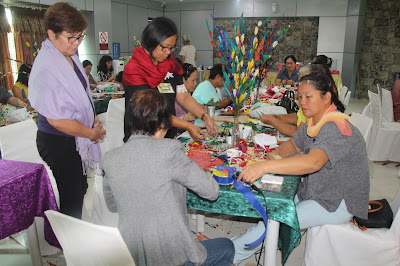
Seeing the potential of the products and to empower women to help augment family's income, DA Caraga through the Corn Program conducted recently a Corn Processing Utilization Training in Butuan City.

The participants who were mostly farmer’s wives were taught on creating gift or decorative products utilizing corn husks through the resource person Ms. Lucila Esdrelon, a retired employee of the Provincial Agriculture Office of the Province of Agusan del Norte.

Notably, few men also took part in the training with equal eagerness to learn the craft.

Lucila Esdrelon appealed to the farmers, not to treat corn husk as farm wastes but an opportunity to earn more.

“Lot of decorative products can be made out of corn husk where wives can maximize their time and help contribute to family’s income,” she said.  

Editha Dedomo, Rural Improvement Club (RIC) Federation President of Esperanza, Agusan del Sur said that she is so happy that she was chosen as one of the participants on the said training as it enhanced her knowledge more on the handicraft making.

“I’ve been doing this craft for quite sometime. During graduation time,  lei out of corn husk is a sought after products, so I can make money of out it, or gift items during a wedding, so it is really a big help for my family,”

Meanwhile, Annabelle Coral, Vice President of the City of Cabadbaran Abaca Handicraft Makers Association Incorporated shared that corn husk handicraft making needs patience and perseverance since you need to give attention up to its minutest detail of the design to come up with an attractive and elegant product,’ she said. 

After the training, various decorative and gift item products had been made that surely capture the eye of the would be costumers. A decor product from corn husk could be sold from P75 and as high as P500.00 depending on its size and intricacy.

Indeed, there is money in trash (may pera sa basura). (Aurelius P. Arais/DA Caraga)


=-###-=

Thursday, March 12, 2020

DA Caraga, BAI and LGU Forges Effort to Prevent Entry of ASF Virus


As the clock is ticking for the country on in its campaign to prevent the entry of the deadly African Swine Fever (ASF) virus, the Department of Agriculture Caraga, Bureau of Animal Industry and local government units pooled its resources to shield the region from the entry of the said virus. 

A stakeholder’s forum on ASF was conducted by DA Caraga through the Livestock Section yesterday to aware swine industry players in the region against the disease.

The virus that posed danger to the swine industry had lately encroached 15 countries in Africa, Europe and some parts of Asia.

“Currently there is no vaccine and medications to fight back the virus, hence, it is a fatal disease,” Dr. Dale Franco Llentic, Caraga Regional Veterinary Quarantine Officer said.

He explained that ASF is a highly contagious hemorrhagic viral disease of domestic and wild pigs of all ages, characterized by high fever, loss of appetite, reddening of the skin and hemorrhages of the internal organs, and death which follows between 2-10 days on the average and mortality can be as high as 100%.

“The only way to contain the disease is through culling or depopulation of the swine in an infected farm such as what had been done in China,” he said.

Historically, the first outbreak was recognized as having occurred in 1907 after ASF was first described in 1921 in Kenya, Africa hence its name has been derived, and it is a reemerging disease on swine.  

However, he clarified that the ASF virus would not affect human. “Physically, ASF virus would affect human but the impact is on economic aspect, since it is a big loss of the swine industry if the entry of such would not be prevented,” Llentic emphasized.

He said that they are focusing on its monitoring and surveillance on the major point of entry in the region such as in Nasipit Port, Lipata Port in Surigao and Pulang Lupa, Trento Agusan del Sur.

The provincial government of Agusan del Norte established a quarantine area in Carmen, Agusan del Norte.

“Quarantine effort is critical in this time so our personnel had been fielded to strictly implement the procedure,” Llentic said.

Entry of domestic and wild pigs and their products including pork meat and semen from affected countries are strictly prohibited based on the memorandum issued by Agriculture Secretary Emmanuel PiƱol since last year.

Edelmira Luminarias, Livestock Program Coordinator appealed to all livestock stakeholders to support the campaign against the entry of the said ASF virus.

“I am appealing to all livestock stakeholders as well as the public to support our effort to prevent the entry of the virus. If you have kin abroad, especially from affected countries, advised them not to bring in as pasalubong any pork products when they got home.” Luminarias said.

Caraga Region’s inventory on swine, as per Philippine Statistics Authority (PSA) data of 2018, there are about 214,486 heads in smallholder raisers or backyard and 11,301 heads on commercial raisers. (Aurelius P. Arais/DA Caraga)

=-###=-

Sunday, March 1, 2020

Gov’t Support Propels Rise of Caraga’s Corn Industry


Strong government support and favorable weather condition have paved the way for the rise of the corn industry in Caraga Region on last year’s cropping season.

Based on 2018 corn performance data, Caraga Region posted positive in comparison to previous 2017 data in terms of area harvested, production and the yield.

As per Philippine Statistics Authority (PSA) record, in 2017 the area harvested for the corn in the region was 34,034 hectares with a total production of 119,980 metric tons (MT) and an average yield of 3.53 MT per hectare.

Last years’ performance exceeded the 2017 record, with 36,699 hectares area harvested and produced 135,627 MT with an average yield of 3.70 MT per hectare.

In comparison, the area harvested from 2017 to 2018 posted an increase of 2,665 hectares or an increase of 8% while the production posted an increase of 15,647 MT or 13% while the yield increased with 0.17 MT or an increase of 5%.

Melody Guimary, DA Caraga regional corn program coordinator said that last year’s increase was due to favorable weather condition for corn production and the support extended by DA Caraga to the farmers.

“Our support to corn farmers had led the way for an increase of Caraga’s performance in corn industry in 2018,” she said.

DA Caraga had distributed around 60 million pesos of agricultural equipment for farm mechanization and post-harvest facilities in 2018 such as farm tractors, corn picker, combine harvester, compact corn mill, vertical dryer and other.

Aside from mechanization support, DA also continually extended technical support through training, corn seeds and ameliorant, and market support.

‘This year, 2019, we are hopeful that the momentum will continue for better production and looking forward to more vibrant corn industry in the region,” Guimary said.

She said that for 2019, the corn program is targetting to increase the corn production from 135,627 MT to 152.000 MT or an equivalent to additional 3,000 hectares of corn area.

“Though our projection is not that easy, we are closely working with the local government units (LGUs) in identifying new areas for corn production that would eventually contribute to the increase of our production for the current year,” Guimary explained.

With an open mind of the farmers to embrace right farming technology and favorable weather condition, Guimary is optimistic that 2019 would be another great year for the corn industry in the region. (Aurelius P. Arais/DA Caraga)

-=###=-

Monday, August 26, 2019

Corn Farming: A Way of Life

Corn Model Farm at Lingayao, Las Nieves, Agusan del Norte

Corn farming is our way of life.

Danilo Dismar, a farmer of Azpetia, Prosperidad, Agusan del Sur said that since his childhood, corn farming is the main source of livelihood of his family.

“When I was still a small boy, I keep on helping my father in tilling our farm. This is a way of life that passed on from generation to generation,” he said.

Mang Danilo as fondly called preferred to plant white corn over yellow corn. “I preferred to plant white corn because this is our family’s traditional food,” he said.

Mang Danilo is the president of Azpetia Farmers Association with 65 members.

He said that when he heard that the Department of Agriculture (DA) has a project to establish flint type white corn model farm, he and his association members gladly accepted to be a farmer-cooperators.

During August 2018 planting period, the association planted around 50 hectares of white corn with free inputs provided by the DA. The counterpart of the cooperator is the area to be planted and labor.

“We were not hesitant to support the campaign of DA to promote white corn since it is our food too, and besides we were able to sell some of our products to buyers at a reasonable price,” he explained.

Aside from Azpetia Farmers Association, another association in Las Nieves, Agusan del Norte also became a recipient of the program, the Brgy. Lingayao-Maningalao Corn Growers Association.

Nicamel Bajao, a member of the Brgy. Lingayao -Maningalao Corn Growers Association expressed his gratitude to DA for the project and for extending support in marketing his produce.

“I am so thankful to DA that aside from giving us the technology and the inputs, they supported us in marketing our products,” he said.

In the combined area of 100 hectares of the two model farms, a total of 52 farmers participated and were able to harvest 423 metric tons (MT) with an average yield of 4.5 MT per hectare and a net income of P23,850.00 per hectare.

In 2019,  DA Caraga targetted additional one site for the model farm.

“Aside from Prosperidad and Las Nieves that will continue as model farm site, we will be establishing another one at Tago, Surigao del Sur,” Melody Guimary, regional corn program coordinator said.

As per guidelines, DA will provide the required seeds, fertilizer, pest and disease control inputs as well as marketing support while the farmer-cooperators will establish the farm of at least 50 hectares compact area per site.

“Model farm aims to showcase appropriate technology in producing white corn to serve as learning sites for other farmers,” Guimary explained. 

Establishing a white corn model farm is one way of promoting white corn consumption, in support of Rice Corn Blend (RCB) Campaign. Filipinos are encouraged to eat corn, either pure or blend it to rice at their preferred ratio whether 30:70, 50:50 or 70:30 corn to rice mixture. 

Corn is rich in vitamins and minerals and known for its low glycemic index which is good for diabetics.

Glycemic index is a numeric scale used to indicate how fast and how high a particular food can raise a person’s blood glucose or blood sugar level. (Aurelius P. Arais/DA Caraga)

=-###=-

Monday, April 8, 2019

RP on Alert Against African Swine Fever


The government is on heightened alert to prevent the entry of a deadly virus that may affect the swine industry in the country, the African Swine Fever (ASF).

Department of Agriculture Assistant Secretary Enrico Garzon, Jr. said that AWF is a deadly virus that if a pig can contact the virus, 2-10 days it will die eventually and will also affect the whole herds in just a span of few days.

“The problem with this virus is that as of now there is no vaccine yet,” Garzon revealed.
Garzon said that swine is a multi-billion industry in the country, that is why the government is implementing all possible measures to prevent the entry of the said virus.

“DA through the Bureau of Animal Industry (DA-BAI) is heightening its monitoring and surveillance in all point of entry of the country from overseas, whether airport and seaport, to protect our swine farmers,” he said.
“We are also closely working with the Bureau of Customs to allow our personnel on x-ray area for baggage to prevent the entry of meat and meat by-products from affected countries,” he revealed. 
Countries currently affected with ASF were Latvia, Poland, Romania, Russia, Ukraine, and China.
However, Garzon clarified that the public should not panic on ASF since it will not affect other animals and or human.
“ASF is a virus-specific on swine. Since it is host specific, it won’t affect on a cow, or other animals, and even on human,” he said.
Historically, the first outbreak was recognized as having occurred in 1907 after ASF was first described in 1921 in Kenya, hence its name has been derived, and it is a reemerging disease on swine. 
Signs of illness include high fever, weakness, and decreased appetite. The skin may be reddened, or have blackened lesions, especially on the tail, ears, and lower legs
DA Secretary Emmanuel PiƱol issued a memorandum, declaring the temporary ban on the importation of domestic and wild pigs and their products including pork meat and semen originating from Latvia, Poland, Romania, Russia, Ukraine, and China.

PiƱol also ordered the immediate suspension of the processing, evaluation of the application and issuance of sanitary and phytosanitary (SPS) import clearance of the said commodities.
In Caraga Region, Doctor Dale Franco Llentic, Regional Veterinary Quarantine Officer said that precautionary measures have been implemented in seaports and airports.

“We are strictly implementing footbath on points of entry here in Caraga Region as well as the hanging of streamers to raise awareness of the public on the said disease,” Llentic said. (Aurelius P. Arais/DA Caraga)


=-###=-

Sunday, March 31, 2019

DA Supports Campaign against Food Loss and Waste


Minimizing food loss and wastage is everybody’s concern.

Assistant Secretary for Livestock Dr. Enrico Garzon, Jr., of the Department of Agriculture
(DA) underscored the importance of cold chain for maintaining the quality of food products.
On his keynote address during the Cold Chain and Food Loss Summit last January 24-26, 2019 held in Butuan City, Garzon lauded Winrock International which implemented Philippine Cold Chain Project (PCCP) in Caraga Region.
PCCP is funded by the United States Department of Agriculture (USDA).
 “We are grateful to USDA and Winrock International for implementing such noble project in Caraga Region, as it boosts government’s program in promoting the use of appropriate post-harvest equipment to prolong the shelf life of a farm product, thereby suppressing food loss and wastage,” he said.
United Nations Industrial Development Organization (UNIDO) defines cold chain as “the set of resources used to maintain temperatures that preserve the quality of products from production to consumption.”
To arrest food loss and wastage, Winrock International implemented cold chain projects in collaboration with local government units and people’s organization.
Winrock International technical director Olegario Ayensa, Jr. said that PCCP is a five-year project to formally end its operation on March 2019.
Since 2015, Winrock International has established 17 improved and cold chain facilities in the region such as slaughter houses, meat cutting plant, dry storage facility, multi-purpose processing facilities, and food safety equipment.
“As the program has come to an end, we are closely working with the beneficiaries for the sustainability of the projects even though the program is no longer around,’ Ayensa explained.
Food loss refers to any food that is spilled, whether accidentally or intentional, spoiled,  discarded (wilted, bruised) along the food chain before it reaches the retail stage such as rejects at harvest while food waste refers to any food that was not consumed due to spoilage, accidentally or unintentionally discarded  at the retail and consumer levels  such as expired food, overripe fruits, cooked and raw food that an individual failed to consume, leftover after meals, and more.
Based on 2015 data of the Food and Agricultural Organization (FAO), one-third of food produced in the world for human consumption is lost or wasted.
“Food wastage is about 1.3 billion tons per year which amount to roughly 680 billion US dollars in industrialized countries and 310 billion US dollars in developing countries. This can already feed millions of individuals suffering from hunger and malnutrition across the globe,” the data stated.
Accordingly, 40-50% food wastage globally accounted on fruits and vegetables including root crops and tubers, 35% on fish and seafood, 30% on cereals and its products, 20% on meat and dairy, and 20% on seeds and pulses.
In support to global effort to minimize losses and wastage, Philippine’s DA has been implementing farm mechanization program to help farmers boosts their production and improve quality of produce for safe and affordable food through the provision of the right technology and appropriate farm and off-farm equipment such as farm tractor, harvester, dryer, milling equipment, and among others . (Aurelius P. Arais/DA Caraga)

=-###=-


Friday, March 29, 2019

Soil Mapping Tool for Agricultural Development


A map is essential in planning for agricultural development.

Thus, Agriculture Secretary Emmanuel PiƱol directed the Bureau of Soils and Water Management (BSWM) to conduct a nationwide soil mapping for soil fertility and suitability.

DA-13 RED Abel James I. Monteagudo (center) run through the suitability map.
In Caraga Region, BSWM has already come-up with soil suitability map for rice in five provinces and initially includes other commodities.

Senior Agriculturist Salvador Fabula of BSWM and Soil and Water Area coordinator Marcelo Dayo presented to DA Caraga Regional Executive Director Abel James I. Monteagudo the result of soil mapping for the Province of Dinagat Islands (PDI) recently.
The map which was eventually turned-over to PDI contains soil suitability on ten various commodities such as coconut, fruit trees, banana, coffee, cacao, pineapple, root crops, corn, vegetables, and rice.
Monteagudo lauded BSWM for coming up with the map as it is a great help for the LGU development planners and farmers as well.
“We owe BSWM for this very valuable document since it could serve as a basis to ascertain what are the interventions needed in a particular area to develop agriculture,” he said.
Through the map, farmers would know what particular commodity is suitaible in their specific area and the needs for fertilization. 
“I hope that the respective LGU will maximize the use of the said map as it is so important especially in guiding the farmers,” the director said.

Farmers can access the said map through their respective LGU and or through BSWM website. 
Under the administration of President Rodrigo Duterte, ten basic foundations of a sound agriculture and fisheries programs were identified wherein a national color-coded agricultural guide map is on top of the list.
Other priorities include national food consumption quantification study; institutional restructuring and paradigm resetting for the Department of Agriculture and its officials and employees; intensive technology updating and sharing, modernization and mechanization program; and easy access financing program for farmers, fishermen and agriculture and fisheries stakeholders, or known as production loan easy access (PLEA). 
DA also implements strategic and effective post-harvest, storage and processing facility; government-initiated and supported aggressive marketing campaign especially for high-value crop;  national livestock, dairy and poultry program; relentless campaign for the enforcement of agricultural and fisheries laws, especially on land conversion and illegal fishing; and re-introduction of basic agriculture in the primary and elementary grades of the Philippine schools system.

=-###=-

Friday, February 8, 2019

DA Conducts Rice Corn Blend Sensory Test


No dominant  aroma, enough stickiness, and  balanced taste.

These are the traits that makes 50:50 ratio of rice corn blend (RCB) a preferred choice based on the result of the sensory evaluation conducted by the Research Division of the Department of Agriculture (DA) Caraga during the CY 2018 Corn Program Year-End Review and Assessment recently.
The sensory evaluation was participated by 51 respondents composed of 15 male and 36 female who are mostly local government unit based -agricultural extension workers and DA Region staff.
Participants were asked to choose their preferred ratio of cooked rice and corn in terms of tenderness and moistness, stickiness, and aroma and flavor. Ratio samples were 30% rice and 70% corn, 50:50 or equal ratio of rice and corn, and 70% rice and 30% corn.
The 50:50 ratio which means equal volume of rice and corn dominates across the 3 attributes.

Agriculturist Benjie Duque of Research Division who facilitated the sensory evaluation said that based on observation, the three different rice and corn mixure had varied cooking time. Each sample mixture was cooked wth the same amount of water in 3 separate rice cooker. 
“The 30:70 ratio cooked at 21 minutes, 50:50 cooked at 23 minutes, while 70:30 was 25 minutes ,”  Duque said.
RCB is an initiative of the Department of Agriculture in collaboration with the PhilMaize Federation to encourage Filipinos to eat white corn to help the country attain food sufficiency and enjoy the health benefits corn has to offer.
Corn has low glycemic index hence good for diabetics and health conscious individuals. (Aurelius P. Arais/DA Caraga)

=-###=-

Thursday, January 17, 2019

Farmers’ Life Easies with Farm Mechanization


“Farm mechanization makes our life easier.” 
Photo Credit: Enrick Tiquil/DA Caraga
This is how Carlito De Paz, president of one of the oldest farmer association in Agusan del Sur, the Boan Barangay Irrigators Development Association Incorporated (BBIDAI) in Rosario, Agusan del Sur described with the advent of mechanizing agriculture. 
BBIDAI was formed way back 1977 started as a group of rice farmers; an irrigation recipient of the National Irrigation Administration, and as time goes by progress into an enterprising association.
With strong leadership, BBIDAI became a recipient of various interventions from the Department of Agriculture.
“We are fortunate that DA provides us various support such as a rice planter, farm tractor, multipupose drying pavement, multipurpose open storage, rice mill with building, warehouse, and combine rice harvester,” De Paz said.
He said that with support of government agencies such as DA, they are now engaged in various services for their 178 members such as marketing, trading, mortgage, savings and loan and agri input provisions.  
“The support of DA really makes our life more convenient especially during harvesting. With the provision of rice combine harvester, harvesting is no longer laborious as compared to manual and it can be done in a faster time,” De Paz explained.
Using the combine harvester, a three-hectare ricefield could be done in just three hours, but in manual harvesting for an average of 10 persons, the three-hectare could be done in a whole day.
Rice farm owners could also save a lot since in manual harvesting, for every 100 sacks of harvested palay, the payment could be 8 sacks for the harvester plus another 8 sacks for the tresher or a total of 15 sacks; while with combine harvester for every 100 sacks of palay harvested, the payment is only 10 sacks. Moreover, palay wastage is only minimal in using mechanization as compared to manual process. 
“Undoubtedly, farm mechanization is a big help for the farmers. We could save time, effort, and money,” De Paz said.
True to its name, rice combine harvester combines basic important job during harvests such as harvesting, threshing and grain cleaning or winnowing and morever, sacking of the harvested palay.
From its income from various services, the association had acquired additional two units of combine rice harvester servicing its members and non-members as well. 
Currently, DA has also established recirculating dryer for the association which soon to be in service. (Aurelius P. Arais/DA Caraga)


=-###=-

Monday, January 7, 2019

Farmer’s Group in Surigao del Sur Receives Farm Machinery from DA Caraga


To help boosts rice and corn production in Madrid, Surigao del Sur, the Department of Agriculture Caraga turned-over various Pre and Post Harvest Facilities (PPHF) in the said town recently.
Photo credit: DA-APCO SDS
In an interview over Bahandi sa Kaumahan radio program, June Anthony Ouano, chief of the Agricultural Program Coordinating Office in Surigao del Sur said that two farmer associations were recipient of the said farm implements, particularly the PABANTABA Farmer’s Association and Upper San Antonio Farmer’s Association.
PABANTABA, a cooperator of a Rice Processing Center in Madrid, received one unit of rice combine harvester, one unit mobile corn mill and one unit rice transplanter while Upper San Antonio received one unit of rice combine harvester.
Ouano said that the turned-over ceremony was a festive occasion as local government officials attended the ceremony headed by municipal mayor Baladay Kimura.
“PABANTABA Farmer’s Association was given the mobile corn mill to help them process white corn into grits as a way of promoting rice corn blend in the locality,” Ouano explained.
Corn is an alternative source of carbohydrates known for its low glycemic index which is ideal to control spike of blood sugar.
On the other hand, Ouano reiterated that government supports are focused on an organized group of farmers.
“Those who are intested to avail government interventions, they should have to be organized and coordinate with their respective local government units through the municipal agriculture office,” he said. (Aurelius P. Arais/DA Caraga)


=-###=-

Sunday, January 6, 2019

Caraga Region is Rich in Tuna


Commercial fishing of tuna and processing is one of the potential investment opportunities in Caraga Region.
Visa Tan-Dimerin, the new regional director of Bureau of Fisheries and Aquatic Resources (BFAR) Caraga said that the region is rich in high-value fish such as tuna.

“We have abundance of tuna in Caraga Region but bulk of our catch goes to other places in Mindanao where post-harvest and processing centers are located such as in General Santos City,” the director said.
Director Dimerin said that Surigao del Sur is one of the sources of fresh catch of tuna for the tuna processing industry in General Santos.
“Caraga is blessed of various tuna species such as skipjack or commonly called tulingan, yellowfin, bluefin, albacore and other,” Dimerin narrated.
She said that currently there are small-scale processors of tuna in the region for bottled tuna products and semi-processed.
“We are promoting our region to investors to consider Caraga Region particularly in fish processing industry so our local catch would be processed here, since we have abundance of fish,” she said.
The director revealed that Caraga Region posted an 88% sufficiency level of fish, however she said that part of Caraga’s catch has been accounted in another region.
“Based on statistics parameters, accounting for fish is based on landing or where it is being unloaded. So in the case of fresh catch from Caraga Region being unloaded outside the region, the data will be credited to the said area,” Dimerin explained.
Dimerin disclosed that 90% of tuna catch in Surigao del Sur particularly from Bislig area are bound for General Santos tuna processing.
Yellow fin in particular, has been exported to other countries such as in Japan and China, hence cold storage facility is neccessary to maintain its quality and such big facility are located in other region.
To boost the fishing industry in the region, BFAR has been conducting training for the fisher folks, provision of fishing paraphernalia and facility for fish processing, and stringent implementation of fishery laws. 
BFAR is an attached agency of the Department of Agriculture. (Aurelius P. Arais/DA Caraga)


=-###=-

Thursday, December 20, 2018

DA Caraga Joins International Summit for Women Entrepreneurs in Nepal


Image credit: SAWDF fb page
Equality begins with economic empowerment.
An international call of the women in the world for gender equality through empowering the women economically. As such, the International Women Entrepreneurs Summit of 2018 was held at a hotel in Nepal last September 3-5, 2018.
The said summit was a gathering of representatives of women entrepreneurs from South Asian countries comprised of Bangladesh, Bhutan, India, Maldives, Nepal, Pakistan, Sri Lanka and Afghanistan; and Southeast Asian countries such as Indonesia, Thailand, Laos, Cambodia, Vietnam, Philippines and China. 


There were also reprentatives from United Kingdom, Switzerland, Nigeria, Egypt, Bahrain and Jordan.

Philippines sent off its two delegates, fortunately, both are coming from Caraga Region, namely, supervising agriculturist Isabelita Ocampo of the Department of Agriculture Caraga and 2016 Outstanding Rural Woman Paterna Velasquez, chair of Mangagoy Fishermen Multi-Purpose Cooperative (MAFISCO) of Bislig City, Surigao del Sur.
Pramila Acharya Rijal, president of the South Asian Development Forum warmly welcomed all the delegates during the inaugural event.

Rijal said that the gathering was a diverse women’s participation promoting women entrepreneurship as well as boost its participation in business and marketing.
Various topics were discussed during the summit focusing on the role of women in business and challenging them to embrace e-commerce to at least maintain its market share in the ever changing market place.

Upon hearing the importance of ecommerce, Velasquez feels the need to embrace the technology for her cooperative to sustain its business enterprises.
MAFISCO humbly started as a group of small fisherfolks, fish traders, marine products traders and ice distributors in 1994, with an initial paid-up capital of only P16,150.00, and now a multi-million cooperative engaging in prototype mini banking operation, operating its own ice plant and cold storage facility, rice trading, and other business venture.

Various government agencies extended its services to the cooperative including the Department of Agriculture Caraga. (Aurelius P. Arais/DA Caraga)


=-###=-


Wednesday, December 19, 2018

DA to Determine Prevalence of Schistosomiasis on Farm Animals


Photo Credit: Wilfred C. Abrea
To determine the extent of schistosomiasis on farm animals, the Bureau of Animal Industry (BAI) of the Department of Agriculture is eyeing  Animal Disease Diagnostic Laboratories  (DA-RADDL) to include schistosomiasis diagnosis on its array of services for the farmers

To capacitate laboratory personnel all over the country, BAI and Research Institute for Tropical Medicine (RITM) of the Department of Health conducted a 3-day extensive training in Butuan City hosted by DA Caraga RADDL on October 2-4, 2018.
Unknown from the general public, schistosomiasis is not only affecting human but it also affects animals especially farm animals since they are exposed on infested water.
According to WHO,  schistosomiasis is an acute and chronic disease caused by parasitic worms wherein people are infected during routine agricultural, domestic, occupational, and recreational activities, which expose them to infested water.

“Schistosomiasis is affecting animals in the farm but as of now we don’t have data concrete on how prevalent is it in the country since its study generally focuses on the human side,” said Dr. Daria Manalo, chief science research specialist of RITM.
She explained that farm animals exposed on areas with the presence of the intermediate host snail called Oncomelania species will most likely to be infected by the disease.

“Oncomelania species of snail is a very small as small as the tip of the ballpen ,” Dr. Manalo described.  She rolled out the common notion that the parasite causing disease can be contacted from the golden apple snail (GAS) commonly seen in rice paddies or irrigation canal linings.
“Based on available studies, GAS is not a host of the parasite, it is only the Oncomelania species,” she explained.
“As of now there is no specific study yet to determine the effect of the schistosomiasis on the animals hence previous cases of the animals might be attributed to other disorders,” Dr. Manalo said.

Dr. Esther CardeƱo, chief of the DA Caraga RADDL said that diagnosis of schistosomiasis on animals is currently not part of the services being offered.

“We are leaned towards schistosomiasis diagnosis but we are still waiting for the diagnosis protocol being finalized by RITM,” Dr. CardeƱo said.
“As soon as the protocol has been finalized, DA Caraga will include schistosomiasis diagnosis,” she added.
Dr. CardeƱo said that presence of schistosomiasis on animals can be determined through the fecal sample to be analyzed in the laboratory.
As preventive measure CardeƱo urged the public to wear personal protective equipment (PEE) if submerging in a known infected area is unavoidable and to maintain personal hygiene, especially in proper fecal disposal since egg of the parasite that causes schistosomiasis might be spread through waste excretion. 
World Health Organization (WHO) reported that the economic and health effects of schistosomiasis are considerable and the disease disables more than it kills. In children, schistosomiasis can cause anemia, stunting and a reduced ability to learn, although the effects are usually reversible with treatment. Chronic schistosomiasis may affect people’s ability to work and in some cases can result in death. 
“The number of deaths due to schistosomiasis is difficult to estimate because of hidden pathologies such as liver and kidney failure, bladder cancer and ectopic pregnancies due to female genital schistosomiasis,” WHO added. (Aurelius P. Arais/DA Caraga)


=-###=-

Tuesday, October 16, 2018

Government Allocates Loan Support for Farmers to Boost Rice Production


To help boost rice production in the country, the government is extending funding support for the farmers in irrigated areas.
Dubbed as Sikat Saka, a lending support exclusively for irrigated areas through Land Bank of Philippines (LBP), a total of P1.6 billion has been allocated for the program nationwide that started since 2012.
Initially, the program covered only 25 provinces but eventually expanded to 45 provinces in the country. In Caraga Region, Agusan del Sur is the sole province covered by the program since Agusan del Sur has the biggest area of rice production among five provinces in the region with almost 50,000 hectares.
Maria Theresa Espinido, Agricultural Program Coordinating Officer of Agusan del Sur said that Department of Agriculture conceptualized the Sikat Saka in support to the Food Staples Sufficiency Program.

“This program aims to help palay farmers to access timely, adequate and affordable production credit,” she explained.
Under Sikat Saka, a small farmer in an irrigated area duly endorsed by an accredited irrigators’ association through National Irrigation Administration (NIA) can access credit assistance of P41,000 per hectare for inbred and P50,000 per hectare for the hybrid.
Small farmers refer to farmer tilling at least one half (1/2) hectare of irrigated land but not to exceed five (5) hectares.
“Currently, a total of 60 farmers had already availed the lending program amounting to P5 million and we are encouraging other farmers to avail the fund,” Connie Galeon of Land Bank of the Philippines South Caraga Lending Center said.
Funding support can be utilized solely for palay production based on farm plan and budget certified by the respective local government unit.
Sikat Saka has a diminishing interest rate starting from 15% down to 9% per annum upon reaching the eighth crop cycle. (Aurelius P. Arais/DA Caraga)
                                                                       
                                                                         -=###=-

Thursday, October 4, 2018

Ensuring Food Supply thru Consumers and Farmers Resiliency


Amidst the current spike of the price of rice, members of the Grains Monitoring Team (GMT) in Caraga Region is eyeing strategies to promote resiliency among consumers and farmers.

Melody Guimary, corn program coordinator of the Department of Agriculture Caraga said that rice is not the only source of carbohydrates but to include other food staples such as banana, root crops, and corn.

“It is high time that people should try to explore other food sources such as corn grits, ” Guimary said.

She said that DA is currently campaigning for the consumers to include corn in their table through Rice Corn Blend (RCB).

“On their preference ratio, consumers may mix corn and rice to lessen the cost of food in the family since price of corn is lower than rice to almost double, thus extending the value of peso ” Guimary explained.

She also said that DA is aiming to boost production of the flint type white corn through the establishment of model farms currently at Las Nieves and Prosperidad, Agusan del Sur.

Aside from production, DA is also embarking for aggressive marketing through establishing local processors to engage in processing and blending of rice and corn for convenient access of the consumers,” she said.

Rice and corn might be blended based on consumer preference such as 70:30, 50:50 or it can be 100% pure corn.

“One of the strategies to boost corn production in the region for human consumption is establishing corn processing equipment along side with the established Rice Processing Complex (RPC) so that RPC could not only process rice but to include corn, ” Guimary added.

Marissa Garces, rice program coordinator said that cooperators of RPC in the region, are currently capacitated to be agricultural traders.

“We are helping our RPC farmer cooperators through training not only to process rice but to engage in trading, with the provision of the needed equipment and capitalization so they can start buying the rice produced within the community, processed and sold it at a much lower price, ” Garces explained.

As of presstime, in Caraga Region, there are six RPC’s who are fully operational, two for testing, and seven on going-construction.

GMT is a multi-sectoral body composed of members both from government and private. (Aurelius P. Arais/DA Caraga)


=-###=-


Wednesday, September 19, 2018

Corn Farming: A Vibrant Agribusiness


“I won’t consider farming a mere livelihood, it is business.”

This is how Romeo Ponio, a corn farmer of Las Nieves, Agusan del Norte distinctly defined his job as an agripreneurial.

He said that farming is business since it needs investment financially, intellectually and physically.

"In my experience for almost 30 years of farming, a hectare of cornfield needs an investment of not less than P35,000.00 to cover the needed inputs as well as land preparation” Ponio explained.

“During the whole planting season, you need your technical know-how in maintaining and caring your farm as well as a   physical visitation of the farm, “ he further said.

Ponio, a hybrid corn farmer in the town is also coined as magsasakang siyentista since he has been consulted by fellow farmers regarding farm production.

“To maintain good harvest, aside from following the right technology, it is important to switch to another variety after 2-3 harvest,” he explained.

He said that maintaining the same variety of corn would affect the vigor of the plant so it is recommended to change variety every now and then.

He further said that a hectare would normally harvest 8-10 metric ton (MT) sold at a prevailing farmgate price he would have recovered more than his investment.

"If you can sell your produce at P13.00 a kilo then you would have a net income of around P70,000.00 in a hectare,” Ponio said.  

In marketing, he said that it is not a problem since buyers are the one who will look and approached him even before harvest time. 

The town of Las Nieves has been identified by the Department of Agriculture as a corn cluster area having more than 1,000 hectares planted with corn both hybrid and open pollinated variety (OPV).

For those who are planning to engage in farming but not yet sure what to plant, he enticed them to choose corn.

“In corn farming especially hybrid, you don’t need to devote more of your time since it is less labor and easy to sell comes harvest season,” he concluded. (Aurelius P. Arais/DA Caraga)


=-###=-